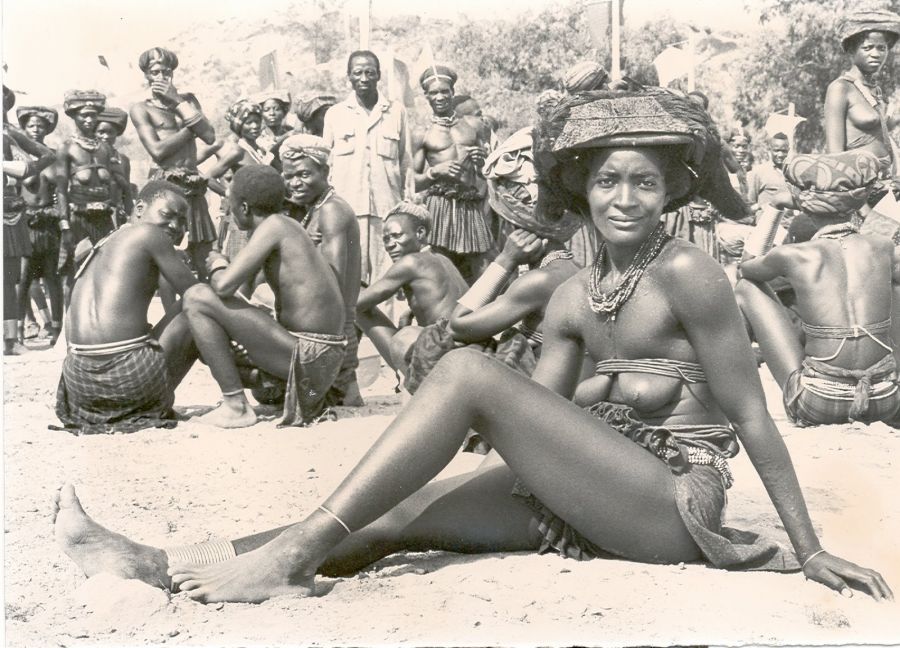
It is in Namibe, south of Angola, where the activity of this ethnic subgroup becomes more intense and visible.
There are a total of 40 thousand inhabitants of this tribe, registered by the State. The Helelo, Herero or Ovahelelo people, from whom the Cuvale (Mucubais) come, left the Great Lakes region around the 16th century.
Its entry into Angola would have been from the extreme east, crossing the Bié plateau, before settling between the Namibe desert and Serra da Chela.
Like any people of Herero or Ovahelelo origin, they are traditional shepherds/cattle breeders who roamed, in the colonial era, along the banks of the Bero, Giraúl, Vintiaba or Bentiaba rivers.
The “Mucubal” territory extends along the slopes of Serra da Chela, then entering the Namibe Desert, getting very close to Chiange. A people whose wealth is oxen, which are the support so that men can support their families and live in harmony.
They can't do without a machete, spear and spears, and are capable of traveling more than 50 kilometers a day. They practice a nomadic life due to the constant search for water, which the desert lacks due to lack of rain.
A reference of perseverance and faith. The Mucubal practice polygamy, a Mucubal can have as many women as he can support.
Around his hut he builds women's huts, one for each woman and thus forms a clan that interacts perfectly and without marital conflicts. His heirs are always his nephews, a sister's children, because he is sure that these are the only ones who are truly of his family blood.
This is an old tradition that is unanimously accepted and respected by all women without causing marital disagreements.
Mucubal women, when single, are naked from the waist up, bare breasts, barely covered by necklaces and bracelets smeared with ox dung, and a short cloth tied to the waist as a skirt.
Married women and mothers, they tie their breasts with thin leather strips (threads) until they are flat. Each Mucubal has a kimbo and several huts displayed in a circle, where all the women and families gather.
The house is made of sand, with cow dung, complemented by sticks that act as a door. Despite the rudimentary material, the spaces are safe and, according to reports, can resist rain, without any infiltration.
They are a community that "challenges" the world with a demonstration of the purity and resistance of African civilization, without resorting to the noblest discoveries of globalization, maintaining semi-primitive habits and customs, in the 21st century.
These are an unmistakable people, who differ from civilized peoples with their typical bracelets, beads and sheepskin turbans, which are essential decorations for women.
Men have different types of hair, each with its own meaning.
A Mucubal may even go unnoticed in the way he dresses, for those who are unaware of his world. However, a simple detail guarantees the authenticity of a limb: the teeth - strictly following a habit that, although little noticed, serves as the only detail to assess the authenticity of a limb: the file of the lower incisor teeth.
The current generation maintains the same habits as their ancestors, in the way of dressing, eating, reproducing and protecting livestock.
Tradition is really demanding and, without it, the Mucubal people die.
This is a simple, humble and hard-working group, with striking social codes typical of African ancestry.
Its tradition reveals a natural wisdom, which is the only way to explain its “victory” and ease of adaptation to the desert. Its bond with tradition is unbreakable.
The community may seem outdated in time and space, but it retains the most typical African wisdom, surviving and resisting the invariable drought for several centuries.
Since the colonial period, it has opted for a diet almost based on wild fruits, milk and its derivatives. Meat, only on special occasions.
Oxen, their greatest wealth, are the center of the Cuvales' social organization, being the source of almost everything they need. It can do a little bit of everything.
From the animal's skin comes the bed, from the milk the food, from the feces mixed with clay the support for houses and from the carcass the tribute to the dead. In this community, the greater the number of cattle, the more respectable the person who owns it will be, hence the entire social organization revolves around this animal species.
Available daily from 08:00 to 22:00. This support line helps clarify doubts, assist with reservations and guide you towards the best accommodation and tourism services.
 English
 Português
 WhatsApp
 Phone
Phone
 Email
Email