Tômbua, also spelled as Tombwa, is a city and municipality on the coast of the province of Namibe, in Angola.
Tômbua, also spelled as Tombwa, is a city and municipality on the coast of the province of Namibe, in Angola.
The municipality has 18,019 km² and around 187,573 thousand inhabitants; The city and host community is the main urban center of the municipality and 60% of the population lives there, the majority of whom are fishermen.
It is limited to the north by the municipalities of Moçâmedes and to the east by the municipality of Virei and the province of Cunene, to the south by the Republic of Namibia, and to the west by the Atlantic Ocean.
The municipality has, in addition to the main commune, which also retains the name of Tômbua, the communes of Iona and São Martinho dos Tigres.
History
The first contact of a European with the bay of Porto Alexandre, a vital geographic landmark for the establishment of the municipality, occurred on an expedition in January 1486, where they reached that huge bay, where they found two large villages, which they called town from Angra das Duas Aldeias.
Another expedition, on September 24, 1839, marks the arrival of captain Pedro Alexandrino da Cunha at a place called Curoca or Angra das Duas Aldeias, which the captain called Porto do Pinda. Captain Cunha's expedition spent 21 days in Porto do Pinda, when it set sail for Tigres Bay, where it arrived on November 1, 1839. Captain Cunha did not establish any business in the areas, preferring the Moçâmedes region.
In 1854, Portuguese colonial enterprises decided to establish a presence in Porto Alexandre (formerly Porto do Pinda) after learning of the visit of a British explorer named James Edward Alexander, who renamed the small Herero village on the banks of the bay as Porto Alexandre. . The Portuguese enterprise consisted first of building a military colony, with the category of town as early as 1855, and; in 1860, they brought several Portuguese from the Algarve, experienced in the fishing art, to form the fishing village of Porto Alexandre and the village of São Martinho dos Tigres (abandoned in 1975).
The municipality of Porto Alexandre was formally created in 1895, maintaining this name until 1975, when it was renamed Tômbua.
Geography
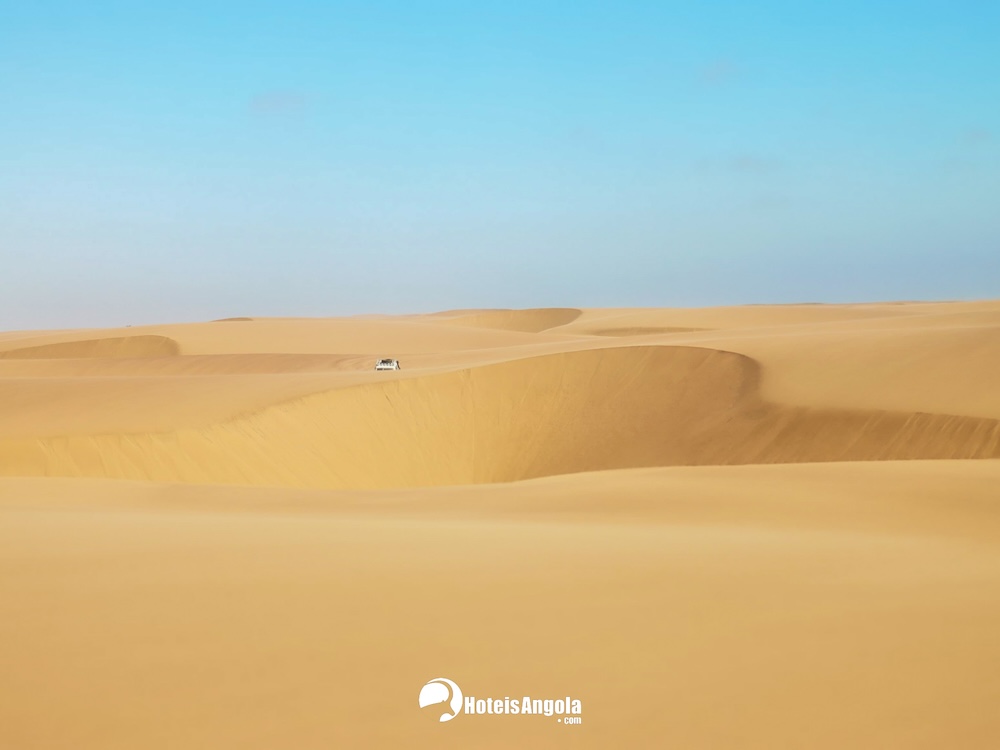
The municipality of Tômbua is the largest in terms of territorial area in the province of Namibe, but is almost completely covered by the Namibe and Caoco deserts. On the border with the province of Cunene it is possible to observe the chains of rocky hills of Serra da Chela, which represent the end of the Namib Desert.
The main geographical reference for the city of Tômbua is the Porto Alexandre bay, which provides the locality with a very well protected port, vital for its fishing economy; other important coastal geographic references are the Tigres Strait and Tigres Island.
Hydrography
Tômbua is the only municipality in Namibe that is supplied by a river that is not intermittent, that is, it does not dry out in its entirety during part of the year; this river is the Cunene, at the southern end of the Tombuense strip.[6] Another important river is the Curoca, for agricultural production in its fertile post-flood areas.
For the supply of drinking water there is also the Arcos do Carvalhão oasis (formerly the São João do Sul lagoon).
Demography and languages
In the interior of the municipality there are the Mucubal, Himba (majority) and Coissã ethnic groups. In the municipality, around 50% of the population uses Portuguese as their primary language; the second most spoken language is Cuvale.
Economy
The economy of the municipality of Tômbua is based on fishing and the industry in the processing of fish and shellfish, with a strict subdivision of activities, with men having the task of fishing, while women are responsible for cleaning and preparing for salting. .
Services related to tourism are also important for the citizens of Tombú, with a lot of demand for hotels, transport and food based on the attractive inhospitable and wild nature of Iona Park, as well as the beaches, the municipality's historical landmarks and the ghost town of São Martinho dos Tigres.
The industry is concentrated in the processing of sea fish and in the inn and maintenance of vessels, generating a certain wage bill.
Culture and leisure
Leisure spaces for residents include the natural landscapes of the Namibe and Caoco deserts, the Lagoa do Arco oasis, the savannas guided by the Iona National Park, the ruins of São Martinho dos Tigres and the island of Tigres. Other places, more distant and less accessible to residents, are freshwater baths in the Cunene River and contemplation of its mouth, and the Monte Negro falls
In the Iona National Park — one of the largest and most biodiversely rich in Angola — there is a wide variety of animal species such as olongos, springboks, ostriches, meerkats, lions, foxes, hyenas, zebras and guelengues, among others. others.
At the mouth of Cunene you can observe alligators and other species of aquatic and terrestrial animals as it is a spawning place. Hunting is prohibited in this area.





 English
 Português