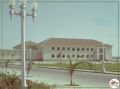
The history of the Moçâmedes Railway is inseparable from the history of the city of Lubango. In 1923, the railway reached Lubango, where the then Vila de Sá da Bandeira would be founded. Work on the line had begun almost twenty years earlier, in 1905, in the port of Moçâmedes. In the meantime, the first world war took place, which forced the works to stop. At that time, the line had already reached Vila Arriaga (now Bibala), in 1912. But it was only ten years later that the line would reach the city of Sá da Bandeira.
The Moçâmedes-E.P Railway, is located in the South of Angola, created at the mercy of the authorization of the Portuguese Government in accordance with the letter of Law of September 15, 1890, for the construction of its railway line, on September 28, 1905, it assumed itself as a public business entity dedicated to the mobility of passengers, goods and mail, on a route of 860 km of general line originating in Moçâmedes and going to Menongue , with 2 branches Chela / Chanja and Entroncamento / Tchamutete due to the exploration of Cassinga iron ore.
It has been more than 100 years since the first stone was laid in the then Moçâmedes District and its main objective was to reach the Huila Plateau towards the Gambos Region, rich in cattle and goats, at a time when the means of transport used in the Region was the so-called “Boer”, an animal-drawn car.
With a gauge of 0.60 meters, and material of 15 kg/m (rail) in the era of the well-known wood-fired train, technical variants have been tested over time, since the use of steam locomotives.
CFM was created with the expectation of valuing the “breadbasket” of the interior and the role of the port of Moçâmedes. It then intended to signal a paradigm shift in Portuguese colonial policy, more focused on the effective occupation of the territory, through the inoculation of Portuguese settlers, attracted to the interior of the province, for the dynamization of agriculture and commerce, undertaken by nationals, instead of limit the commercial exploitation of indigenous products.
The preference for the safe port of Moçâmedes was a moral obligation of the Portuguese State towards the colonists who founded civilizing stations on the Chela plateau, where the healthiness of the climate allowed settlement and reproduction of the white race, similar to what happened in the English colonies.
In 1939, there was a need to modernize the line, due to the transport of ore, expanding the gauge from 0.60 to 1.067 meters, a gauge predominantly in the Southern African region , with material of 45 kg/m (rail).
Since then the railway line has been extended by around 747 km, starting from the then District of Moçâmedes, passing through Serra da Chela, at a maximum altitude of 1,914 meters to the area in Quilemba, with a maximum curve radius of 2000 meters and a minimum of 115 in the Serra, comprising around 205 curves with ramps of 28% incline.
After Lubango, the line continued east, reaching Quipungo in July 1955, November 1955 in Matala, May 1958 in Kuvango, May 1960 in Cuchi until Serpa Pinto, now Menongue, and December 1961, followed by the Chela/Chanja and Entroncamento/Jamba/Tchamutete branches.
A branch to the South was also built, the Chibia branch, which arrived in 1955, after around 120 km of railway line.
The construction of the line was therefore completed on the eve of the start of the colonial conflict in Angola. After independence in 1975 and with subsequent internal conflicts, most of the line's infrastructure was affected, having been subject to major rehabilitation and modernization between 2006 and 2015 (by a Chinese company, in line with China's financing) and returning operating.
In 1980, the Company was established by the Angolan State as a State Economic Unit, under law no. 72/1980 of 26 March, published in Diário de República, 1st series.
It is today, the result of the transformation from U.E.E (State Economic Unit) to E.P (Public Company) through Presidential Decree nº 149/10 of 21 July, combined with Law nº 11/13 – Basic Law of the Public Business Sector, whose corporate purpose is the rail transport of Passengers, Goods and Mail, its area of operation covers the Provinces of Namibe, Huíla and Cuando Cubango.
You can organize your story into the following periods:
In the expectation of giving life to the infrastructures of the C.F.M., which since the end of the 60s, had only undergone palliative interventions, in January 2006, it was carried out in the city of Lubango, town of Mukanka, the launching act for the beginning of the rehabilitation and modernization works of the C.F.M., a project completed in 2012 and definitively handed over to the Angolan State by the contractor China Hyway on October 31, 2018, in the city of Lubango.< /p>
Among others, the project included:
CFM currently has its main infrastructures rehabilitated and modernized throughout its entire dimension from the Province of Namibe to Cuando Cubango, including the Jamba and Tchamutete branches, under the gizado program by the Executive for the revitalization of the country's railway sector, which was definitively received in 2017, which now allows us to provide a higher quality service.
57 new stations were built along this line: 3 Special, 7 1st Class, 11 2nd Class Stations and 36 3rd Class Stations.
This time, with the resumption of the Cassinga ore project and others, everything indicates that there is a great need for gradual replacement over the next 5 years, of the entire media park traction and towed vehicles, workshop means for their maintenance, in order to satisfy the demand to which this company will be under pressure, since all palliative interventions with the acquisitions made so far, constitute a drop in the bucket in the face of the challenges facing that which was the last peak of the transport of goods and passengers by the C.F.M. until 1972/73, that is, 6,000,000 tons/year, as an example.
The region will win and its people will benefit, and in this way they will participate in the development of the region in particular and the country in general.
Image Gallery
Headquarters Map

 English
 Português