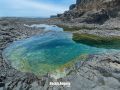
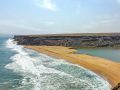
Several kilometers from the city of Moçâmedes, capital of the province of Namibe, is the beautiful and calm Baía das Pipas, a paradisiacal place that attracts visitors from the most different parts of the country and abroad.
Come and recharge your batteries on the region's wonderful, wavy beaches.
Moçâmedes has several natural charms, which aroused our curiosity in getting to know one of the main points on the tourist route in that city. Curiosity took us to one of the paradisiacal beaches located 26 km from the provincial capital.
We departed the capital by land, along National Road 280, which connects the capital of the province of Namibe and the capital of the province da Huíla (Lubango).
The first stop was at the bridge over the Giraul river, which is 12 kilometers from the seat of the Moçamedes municipality. It is a work worth highlighting, a completely prefabricated structure, with a total of 605.70 meters long, 8 meters high, two lanes and connecting the provinces of Namibe and Huíla.
A fearful and enchanting route...
And the journey continues, after stopping for a few minutes to take photographs, we set off towards Baía das Pipas, to explore its beautiful beaches and get to know the daily lives of its people.
After several minutes of asphalt without any bumps , we were surprised by the access road to Cambongue.
We enter the trail that goes to the left and connects Baía das Pipas, Mucuio and Pescaria Baba. Steep road made up of rocks, where experience and years of driving put any driver to the test. It is therefore advisable to use 4x4 vehicles on this route.
To compensate for the bumps in the road, we are amazed by a natural view that would enchant any visitor, the cliffs.
According to information collected on site and from academics, the region is made up of dead cliffs that provide us with clues about the presence of ocean activity and show how far the sea has advanced.
The images of the place make the trip less painful and more enchanting and encourage tourists to take a slow walk with frequent stops for photo opportunities. The journey continues and after approximately 60 minutes of walking, there is a descent to the lowest area of the coast.
When we least expect it, we glimpse the peaceful village of Baía das Pipas, with its beaches.
Perfect place to get lost in the desert and the ocean that bathes the coast of Namibe.
Small, the village was inhabited , according to statistical data from 2015, by just five hundred inhabitants, mostly fishermen.
Stunning tourism with a lack of momentum
The calm and humility of the people make the place one of the main destinations in recent years for visitors from the regions of Huíla, Benguela, Cunene and Luanda and the neighboring Republics of Namibia and South Africa. Spain.
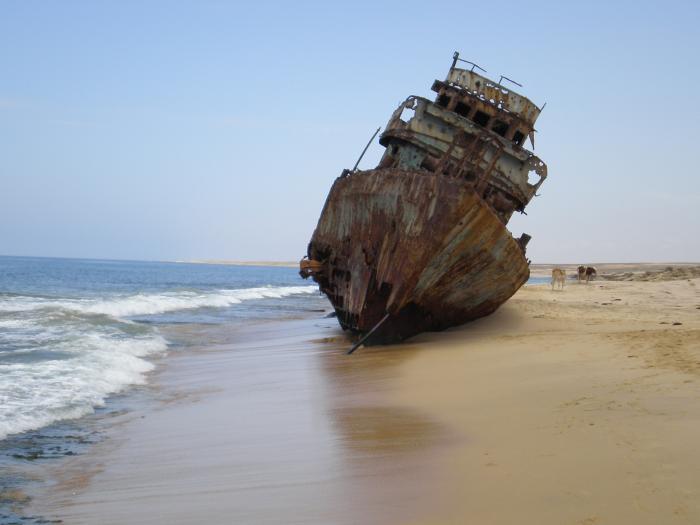
Clear blue sea, land with many stories and impressive natural beauty.
The traces of colonial occupation and the first inhabitants are still visible. More than five hundred inhabitants live in Baia das Pipas, most of them fishermen, and it has schools, health centers, piped water and electricity.
In that area, there are more than twenty beach houses and also a guesthouse with more than ten rooms, restaurants, snack bars, swimming pool and other amenities. Some tourists, enchanted by the natural reality, told our reporter that this place is so calm that any Angolan or foreigner would like to stay longer, sometimes on weekends.
João Carlos, a tourist, said that it is a place where all the necessary conditions can be found for any visitor, as long as they are financially prepared.
Silence is one of the dominant notes of Baía das Pipas, where only sound of sea waves exceed the human ear.
However, Baía das Pipas embodies several historical aspects that aroused the interest of national and international academics.
In 2012, the region was the target of an archaeological survey called “Paleo – Angola”, whose purpose was the excavation and discovery of fossils of dinosaurs and other reptiles that lived in the region many millennia ago.
But not everything is wonderful for the inhabitants of Baía das Pipas. Located 26 km from the provincial capital, tourism lacks momentum, as some infrastructures created with private investment require support for their full operation, along with those in other regions of the country.
Today, the number of inhabitants tends to grow and there is a constant mobility of its inhabitants between the city of Moçamedes and the village of Baía da Pipas, in search of better social conditions.







 English
 Português